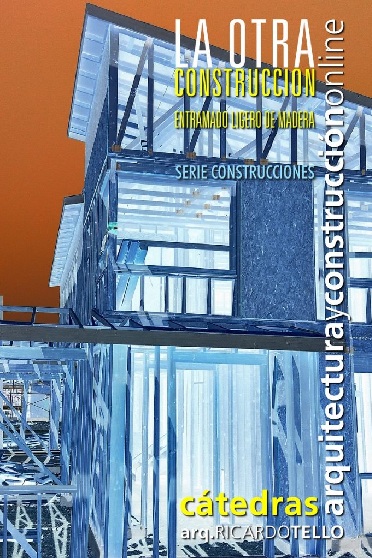
This is what happened to the undersigned in his professional encounter with the Light Wood Frame construction system in the United States of America, after many decades of professional practice with wet technologies in Argentina. Among the surprises, the speed of execution and the notable shortening of construction times and final delivery of a work are relevant.
Regarding new habits, it is necessary to accept the almost leading role of the prefabrication of parts in the workshop with standardization criteria and the reduction of on-site work to almost exclusive assembly tasks, which demand a pragmatic and more relaxed control of the Construction Management. It is obvious that these pragmatic and relaxed situations are directly related to the fulfillment of very short delivery times and therefore do not incur that instance of 'delay', so to speak, due for example to the setting of certain components that is common in wet constructions.
This compliance with the delivery times of the work is almost strict, according to what the Author has verified in various examples of size and/or scale of functional and design complexity. Naturally, the speed of execution makes this compliance possible, but at the cost of a certain disregard for the quality and precision of joints and adjustments of the constructive parts masked by closing or finishing coatings. For the undersigned, it was a blatant surprise to verify all this even in his own home and faced with the need for a renovation; it was like being in front of an imperfect and disorderly skeleton that, however, and it is fair to recognize it, fully fulfilled its structural mission.
These reasons together with the author's experiences motivated this publication whose main objective focuses on the description of the components and stages of the Light Wood Frame Construction System, which is currently the best exponent of what in this eBook has been called 'the other construction', in an attempt at a non-pejorative popular denomination and in contrast to the construction systems based on concrete, iron and masonry also rooted as traditional and in force in many countries. This edition does not intend to carry out an exhaustive analysis of the Light Frame, but rather what is discussed here is designed to initiate Architecture students and anyone interested in different structural typologies, in the knowledge of its basic aspects without exhausting the possibilities and/or descriptive characteristics thereof.
The analysis that follows consists of providing definitions that are always perfectible, generating classifications to order the analysis and giving examples that allow access to the basic and introductory notions of the Light Frame construction system.